Observatory Version of Misc Musings, Ravings, and Random Thoughts

Status
You're currently viewing only Auguste_Fivaz's posts. Click here to go back to viewing the entire thread.

Auguste_Fivaz

Ars Praefectus
5,837
Subscriptor++
From our friends at HVO:

HVO/USGS Volcanic Activity Notice

Volcano: Kilauea (VNUM #332010)

Current Volcano Alert Level: WATCH
Current Aviation Color Code: ORANGE

Issued: Wednesday, November 26, 2025, 12:25 AM HST
Source: Hawaiian Volcano Observatory
Notice Number: 2025/H513
Location: N 19 deg 25 min W 155 deg 17 min
Elevation: 4091 ft (1247 m)
Area: Hawaii

Volcanic Activity Summary:
Episode 37 of the ongoing Halemaʻumaʻu eruption ended abruptly at 11:39 p.m. HST on November 25 after 9.2 hours of continuous fountaining.
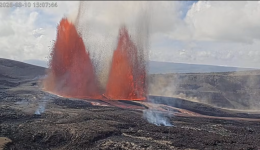
The north vent stopped erupting at approximately 11:39 p.m. HST marking the end of episode 37. No lava fountains or flows erupted from the south vent during episode 37. Dual lava fountains from the north vent reached maximum heights of 500-600 ft (150-180 m). Continuous fountaining lasted for 9.2 hours and produced an estimated 8.2 million cubic yards (6.3 million cubic meters) of lava. The combined average eruption rate was over 200 cubic yards per second (190 cubic meters per second). Lava flows from the fountains covered about 75% of the floor of Halemaʻumaʻu crater.
The eruptive plume reached heights of more than 14,000 ft (4,200 m) above sea level during episode 37. Volcanic gas emissions greatly decreased after lava fountaining ended.
The Uēkahuna tiltmeter (UWD) recorded about 16.5 microradians of deflationary tilt during episode 37. The end of lava fountaining was coincident with a rapid change from deflation to inflation at the summit and a decrease in seismic tremor intensity.
Lava flows from this episode on the floor of Halemaʻumaʻu within the southern part of Kaluapele (Kīlauea caldera) may continue to exhibit slow movement or incandescence as they cool and solidify over the coming days.
Most episodes of Halemaʻumaʻu lava fountaining since the eruption started on December 23, 2024, have continued for around a day or less and have been separated by pauses in eruptive activity lasting generally at least several days.
No changes have been detected in the East Rift Zone or Southwest Rift Zone.
Kīlauea Volcano Alert Level/Aviation Color Code remain at WATCH/ORANGE. All current and recent activity is within Hawaiʻi Volcanoes National Park.


Recent Observations:
[Volcanic cloud height] Unknown
[Other volcanic cloud information] Sulfur dioxide emission rate is typically 1,200-1,500 tonnes/day between eruptive episodes
[Ballistics] N/A
[Lava flow/dome] N/A
[Lava flow] N/A

Hazard Analysis:
[General hazards] Pele's hair and tephra may affect areas downwind of eruptive vents
[Ash cloud] N/A
[Ashfall] N/A
[Lava flow/dome] N/A
[Pyroclastic flow] N/A
[Mud flow] N/A
[Volcanic gas] Usually 1,200-1,500 tonnes/day SO2 between eruptive episodes
[Lava flow] May continue to exhibit slow movement or incandescence as the cool and solidify over the coming days

Remarks:
Hazard Analysis: 

This episodic eruption is occurring within a closed area of Hawai'i Volcanoes National Park. High levels of volcanic gas—primarily water vapor (H2O), carbon dioxide (CO2), and sulfur dioxide (SO2)—are one hazard of concern, as this hazard can have far-reaching effects downwind. As SO2 is continuously released from the summit during an eruption, it will react in the atmosphere to create the visible haze known as vog (volcanic smog) downwind of Kīlauea. SO2 and vog may cause respiratory and other problems at high concentrations. Further information on vog can be found at https://vog.ivhhn.org/

Another hazard closer to the vent is fallout of Pele's hair and other volcanic fragments from lava fountains. Pele's hair is strands of volcanic glass often produced by lava fountaining activity and can be carried well over 10 miles (15 kilometers) from the vent. Other hot glassy volcanic fragments including Peleʻs hair, volcanic ash, pumice, scoria, and reticulite can fall on the ground within 1-2 miles (1-3 kilometers) of the eruptive vent(s) with the highest concentrations downwind of the vent(s). Pumice and other volcanic fragments have fallen on Highway 11 west of Hawaiʻi Volcanoes National Park depending on wind and eruption conditions. Strong winds may waft light particles, including Pele's hair, to greater distances downwind. Once they are on the ground, Pele's hair can sometimes cluster and tangle together, giving it the appearance of a tumbleweed. The extent of Pele's hair deposition is dependent on lava fountaining activity and current wind conditions. Residents and visitors should minimize exposure to Pele's hair and other glassy volcanic fragments, which can cause skin and eye irritation. More information about how Pele's hair, its hazards, and what to do is available here: https://www.usgs.gov/observatories/...t-lava-fountains-highlight-peles-hair-hazards. A recently updated Frequently Asked Questions document that includes information about potential health effects of Pele's hair is available here: https://vog.ivhhn.org/sites/default/files/PelesHair_FAQs_v2.pdf

Hawaiian lava flows generally advance slowly downslope, and during this eruption flows have been confined to Halemaʻumaʻu crater and the southwest side of Kaluapele, Kīlauea's summit caldera.

Other significant hazards also remain around Kīlauea caldera from Halemaʻumaʻu crater wall instability, ground cracking, and rockfalls that can be enhanced by earthquakes within the area closed to the public. This underscores the extremely hazardous nature of Kīlauea's caldera rim surrounding Halemaʻumaʻu crater, an area that has been closed to the public since late 2007.


Contacts:
askHVO@usgs.gov


Next Notice:
HVO continues to closely monitor Kīlauea and will issue a VAN/VONA at the start of the next eruptive episode. If possible, HVO will also issue a Status Report beforehand at the onset of low-level precursory activity. Regularly scheduled daily updates for Kīlauea are posted on the HVO website at https://www.usgs.gov/volcanoes/kilauea/volcano-updates

More Information:


Subscribe to these messages: https://volcanoes.usgs.gov/vns2/
Summary of volcanic hazards from eruptions: https://www.usgs.gov/observatories/hvo/hazards
Recent earthquakes in Hawaiʻi (map and list): https://www.usgs.gov/observatories/hvo
Explanation of Volcano Alert Levels and Aviation Color Codes: https://www.usgs.gov/programs/VHP/volcanic-alert-levels-characterize-conditions-us-volcanoes


View online at: https://volcanoes.usgs.gov/hans-public/notice/DOI-USGS-HVO-2025-11-26T06:35:56+00:00

You have received this message from the Volcano Notification Service (VNS).
Change VNS settings/STOP
From VNS v3
 

Auguste_Fivaz

Ars Praefectus
5,837
Subscriptor++
Space weather is showing a minor disturbance with a G2 (geomagnetic) storm. However, the geoelectric model is going wild right now:


1764786767389.png


While monitoring this daily for a few years, I can only recall one other such storm. The scale is mV/km and the purple is 10K, red is 1K.

1764786673651.png


https://www.spaceweather.gov/products/geoelectric-field-models-1-minute#
 

Auguste_Fivaz

Ars Praefectus
5,837
Subscriptor++
Over on The Guardian is an amazing documentary on the efforts of some Chilean scientists to sample the microbial life in the Atacama Desert before it is plundered further for lithium. They are looking for possible candidates in developing new antibiotics for the current strains of superbugs and drug resistant bacteria.

Beautifully photographed and, at 20 minutes, mercifully to the point, it covers the work of Cristina Dorador and her team.

Cristina Dorador is on an urgent mission in the world’s driest desert, the Atacama in Chile. As the rise of drug-resistant superbugs kills millions per year, Cristina has made it her mission to uncover new, life-saving antibiotics in the stunning salt flats she has studied since she was 14. Against the magnificent backdrop of endless plains, microscopic discoveries lead her team of scientists to question how critically lithium mining is damaging the delicate ecosystem and impacting Indigenous communities

https://www.theguardian.com/society...superbugs-starts-in-the-driest-place-on-earth
 

Auguste_Fivaz

Ars Praefectus
5,837
Subscriptor++
1765080350946.gif

http://www.explorevolcanoes.com/Volcanic rock types.html

From the observatory:

Kilauea Message 2025-12-06 15:11:39 HST
Episode 38 has produced about 13,000,000 cubic yards or 10,000,000 cubic meters of lava over the past 6 hours. The north vent is not erupting, and south vent fountains are below 575 feet. There has been 24.5 microradians of deflation.

Kilauea Message 2025-12-06 12:28:34 HST
Just a note that if you are one of the dedicated observers that watch our instrument data, the "wiggles" in the tilt data were caused by the arrival of the teleseismic waves from the Magnitude 7 Hubbard Glacier earthquake in Alaska.

Kilauea Message 2025-12-06 12:12:38 HST
The high effusion rate of this episode is producing a very dramatic plume extending over 20,000 feet above sea level. There is misinformation being circulated in public that ground water is driving the fountains, but this is not true.

Kilauea Message 2025-12-06 12:00:05 HST
Fountains from the south vent are over 1000 feet high and inclined to the south. The summit has deflated over 16 microradians in 3 hours indicating that the effusion rate for this episode is very high.

Kilauea Message 2025-12-06 10:05:08 HST
The south vent fountain is now over 1000 feet (300 meters) high and inclined to the south. Hot pumice from this fountain destroyed the V3 streaming camera site a few minutes ago. Not a safe place for humans to watch. Thanks to you V3!

Kilauea Message 2025-12-06 09:41:24 HST
Kllauea is producing rare triple fountains this morning. Two are from the double vent in the north cone and one from the south vent. All of the fountains are between 400 and 500 feet (125 and 150 meters) high. Another first!
 

Auguste_Fivaz

Ars Praefectus
5,837
Subscriptor++
Lava fountain engulfs USGS HVO V3cam - December 6, 2025
In case you ever wondered what it would be liked to be engulfed in a lava fountain... This video was recorded by the V3 camera, located on the south rim of Halema‘uma‘u crater at the summit of Kīlauea volcano on the Island of Hawai‘i. The camera, located in a hazardous closed area of Hawai‘i Volcanoes National Park, was buried by tephra from an inclined lava fountain between 9:55 and 9:57 am HST on December 6, during episode 38 of the Kīlauea summit eruption that began on December 23, 2024.


View: https://www.youtube.com/watch?v=H4uSfIYSrNw
 

Auguste_Fivaz

Ars Praefectus
5,837
Subscriptor++
A note from spaceweather.com today:

SEVERE GEOMAGNETIC STORM PREDICTED : A CME is approaching Earth, and it could cause a severe (G4-class) geomagnetic storm when it arrives during the early UTC hours of Jan. 20th. For sky watchers in North America, this means the night of Jan. 19-20. Widespread auroras are possible if the storm reaches its predicted peak intensity. Full story @ Spaceweather.com.

https://spaceweather.com/
SOLAR PROTON STORM IN PROGRESS: Energetic protons from the sun are raining down on Earth. They were accelerated in our direction by yesterday's powerful X-class solar flare (described below). This is called a "solar proton storm," and currently it is category S3. Shortwave radios inside the Arctic Circle aren't working right now due to this storm, which is causing a polar cap absorption event. Currently, there is no danger to air travelers.

SEVERE GEOMAGNETIC STORM PREDICTED Prepare your cameras! NOAA says that a severe G4-class geomagnetic storm is possible on Jan. 20th when a CME is expected to slam into Earth's magnetic field. The CME was launched on Jan. 18th by an X1.9-class solar flare from sunspot 4341:

Researchers call this "a long duration flare." The explosion lasted for hours, which makes it even more powerful than than its "X1.9" rating would suggest. Much of that power went into the CME now approaching Earth.

If NOAA's forecast is correct, the CME will strike during the early hours of Jan. 20th. In North America, that means the night of Jan. 19-20. A severe storm could spark auroras visible to the naked eye in at least a dozen northern-tier US states. Photographic auroras with colors visible only to cameras (and smartphones) could descend as far south as Arizona, Texas and southern California.
 

Auguste_Fivaz

Ars Praefectus
5,837
Subscriptor++
Kilauea is erupting again

1769293151412.png


HVO/USGS Volcanic Activity Notice

Volcano: Kilauea (VNUM #332010)

Current Volcano Alert Level: WATCH
Current Aviation Color Code: ORANGE

Issued: Saturday, January 24, 2026, 11:11 AM HST
Source: Hawaiian Volcano Observatory
Notice Number: 2026/H39
Location: N 19 deg 25 min W 155 deg 17 min
Elevation: 4091 ft (1247 m)
Area: Hawaii

Volcanic Activity Summary:
Episode 41 of lava fountaining in Halemaʻumaʻu began at the summit of Kīlauea began at 11:10 a.m. HST on January 24.
Ground-level sensors near the eruptive vents indicate that winds are light and blowing from the south southeast direction, which suggests that volcanic gas emissions and volcanic material may be distributed to the north northwest direction from Halemaʻumaʻu. Winds are forecast to be light and variable over the next several hours.
Most lava fountaining episodes since December 23, 2024, have continued for a day or less.


Recent Observations:
[Volcanic cloud height] Plume in past episodes has reached up to or above 20,000 feet (6000 meters) above ground level, driven by incandescent lava fountains up to or over 1500 feet (457 meters) high.
[Other volcanic cloud information] Most volcanic ash and pumice (tephra) falls within about 1 mile (1-2 km) of the eruptive vents during eruptive episodes. Lower concentrations of finer volcanic particles, such as ash and Pele's Hair, can be transported greater distances downwind of the vent (20 miles or 30 km). Sulfur dioxide emission rate is typically 50,000-100,000 tonnes/day during an eruptive episode.
[Ballistics] N/A
[Lava flow/dome] N/A
[Lava flow] Confined to Halemaʻumaʻu (within summit caldera).

Hazard Analysis:
[Ashfall] Small volcanic particles may impact downwind areas.
[Lava flow/dome] N/A
[Pyroclastic flow] N/A
[Mud flow] N/A
[Volcanic gas] Typically 50,000-100,000 tonnes/day during sustained lava fountaining episode.
[Lava flow] Confined to Halemaʻumaʻu (within summit caldera).
 

Auguste_Fivaz

Ars Praefectus
5,837
Subscriptor++
Kilauea is erupting today - see above posts for links.

Kilauea Message 2026-02-15 17:36:24 HST
The south vent fountain continues to fluctuate between 800 and 1100 feet (250-350 meters) in height. Maximum effusion rate reached about 1000 cubic yards per second (770 cubic meters per second) during highest fountains around 2 pm HST.

Kilauea Message 2026-02-15 16:49:17 HST
The south vent fountain jetted up to over 1300 feet (400 meters) high. It is fluctuating from about 800 feet to 1300 feet (250-400 meters) high. North vent is about 800 feet (250 meters).

Kilauea Message 2026-02-15 15:34:35 HST
The maximum fountain height for the south vent remains around 1150 feet (350 meters) and about 800 feet (250 meters) for the north vent fountains. No falling ash has been reported at this time.

Kilauea Message 2026-02-15 14:44:55 HST
South vent fountain about 1000 to 1200 feet (300-350 meters) and are about 100-200 feet (30-60 meters) higher than the north vent fountain. NWS reports plume moving to the southwest.

Kilauea Message 2026-02-15 14:24:14 HST
The north vent fountain is approximately 600 feet high (180-190 meters) and the south vent about 400 feet high (120 meters). Fountains are continuing to build.

Kilauea Message 2026-02-15 14:12:24 HST
Fountains from the north vent are currently about 300-350 feet (100 meters) high and south vent fountains are about half that large. Winds are currently from the northeast blowing to the southwest.
 

Auguste_Fivaz

Ars Praefectus
5,837
Subscriptor++
spaceweaather.com is "celebrating" the 70th anniversary of THE 1956 GROUND LEVEL EVENT with details from that date. A very interesting update on what a major flare can do almost instantly.

According to Dyer's calculations, GLE05 would have delivered as much as 10 millisieverts of radiation to passengers on a high-altitude transatlantic flights--comparable to multiple chest CT scans in a few hours. The effect on satellites might have been significant except for one thing: There were no satellites. Sputnik wouldn't be launched until the next year.

How times have changed. in 2026, Earth is surrounded by a swarm of more than 10,000 active satellites with electronics so sensitive that even a single particle of "hard radiation" can reboot onboard computers or or burn out memory locations.
 
  • Like
Reactions: Bardon

Auguste_Fivaz

Ars Praefectus
5,837
Subscriptor++
I was thinking about putting this in the SpaceX thread here, but no.

spaceweather.com has a rant about Starlink streaking astronomical photos - this is what it looks like today. I don't observe or do any astro-photography any longer but if I did ...

1772175034381.png


the commentary Dr. Phillips writes is good.
 

Auguste_Fivaz

Ars Praefectus
5,837
Subscriptor++
Kilauea is erupting again, episode 43. The USGS team has enabled a microphone on the V1 live-stream cam. While the V1 image is blurred you can leave the audio on and tune into V2 or V3 cams for clear visuals. I'm hearing the plink plink of falling stones and the background growl of the fissures over the wind, but it seems to be pretty calm today.

1773191299803.png

From the V3 stream.


HAWAIIAN VOLCANO OBSERVATORY STATUS REPORT
U.S. Geological Survey
Tuesday, March 10, 2026, 12:17 PM HST (Tuesday, March 10, 2026, 22:17 UTC)


KILAUEA (VNUM #332010)
19°25'16" N 155°17'13" W, Summit Elevation 4091 ft (1247 m)
Current Volcano Alert Level: WARNING
Current Aviation Color Code: RED


Activity Summary:
  • Episode 43 of the ongoing Halemaʻumaʻu eruption at Kīlauea summit began around 9:17 a.m. HST on March 10, 2026, and is continuing at this time.
  • Initial fountains began from the north vent with the south vent starting just before 10 a.m. HST.
  • Currently the south fountain is 1150 feet (350 meters) high and the north vent is 1000 feet (300 meters) high.
  • Maximum fountain heights for both vents were over 1300 feet (400 meters).
  • Lava flows are have covered about one third of the floor of Halemaʻumaʻu crater.
  • Precursory overflows began from the north vent at 8:20 a.m. HST and continued directly into the fountaining episode.
  • Tephra fallout, visible in HVO webcams from as early as 9:50 a.m. HST, is creating hazardous conditions in areas downwind, including neighboring communities and Highway 11.
    • Volcano Village and Mauna Loa Estates - up to 3 inches in diameter
    • Royal Hawaiian Estates - up half an inch in diameter and Pele's hair
    • Fallout that nearly continuously covers the ground has been reported at various overlooks in Hawai'i Volcanoes National Park and Volcano Golf Course
  • The National Weather Service has issued an Ashfall Warning: https://forecast.weather.gov/showsi...roduct1=Ashfall+Warning&lat=19.4&lon=-155.289
  • Hawaii County Civil Defense Agency announced the closure of Highway 11 between the 24 and 40 mile markers due to dangerous conditions being created by tephra falling: https://hawaii-county-civil-defense-agency-hawaiicountygis.hub.arcgis.com/
  • Hawai'i Volcanoes National Park has announced that temporary closures around Kīlauea summit are in place due to volcanic hazards. Lodging guests of Volcano House and Kilauea Military Camp will be allowed to enter the park.
  • Report tephra fall: https://hawaiiash.science/report_form
  • Lava fountains from the south vent are currently reaching 1310 feet, while the north vent lava fountains are a little under 985 feet high.
  • NWS/VAAC reports the plume currently reaching 30,000 feet above sea level. Winds from the south are currently pushing the plume to the north.
  • Heed National Park Service and County of Hawaii guidance.
Resources:
Hazard Analysis: 
  • Volcanic Gas: water vapor (H2O), carbon dioxide (CO2), and sulfur dioxide (SO2) are continuously released during an eruption. SO2 reacts in the atmosphere to create the visible haze known as vog (volcanic smog) downwind, which may cause respiratory and other problems. Further information on vog can be found at https://vog.ivhhn.org/
  • Tephra:small glassy volcanic fragments—volcanic ash, pumice, scoria, Pele's hair and reticulite—are created by the lava fountains. A combination of fountaining dynamics and wind conditions determines where tephra fall may occur for any given eruption episode. Larger particles fall near the vents while light particles may be wafted greater distances. These particles may be remobilized during windy conditions following recent eruptive episodes. Residents and visitors should minimize exposure to these fragments, which can cause skin, eye, and respiratory irritation. More information and guidance on tephra fall hazards is available at the links below:
  • Lava flows: generally advance slowly downslope, and during this eruption flows have been confined to Halemaʻumaʻu crater and the southwest side of Kaluapele, Kīlauea's summit caldera.
  • Other: significant hazards exist around Kīlauea caldera from Halemaʻumaʻu crater wall instability, ground cracking, and rockfalls that can be enhanced by earthquakes. Close to the vents, the tephra material on the crater rim is prone to cracking, slumping, and small landslides that sometimes expose hot and molten material within. This underscores the extremely hazardous nature of Kīlauea's caldera rim surrounding Halemaʻumaʻu crater, an area that has been closed to the public since late 2007.


More Information:


The Hawaiian Volcano Observatory is one of five volcano observatories within the U.S. Geological Survey and is responsible for monitoring volcanoes and earthquakes in Hawaiʻi and American Samoa.


CONTACT INFORMATION:


askHVO@usgs.gov


Subscribe to these messages: https://volcanoes.usgs.gov/vns2/
Summary of volcanic hazards from eruptions: https://www.usgs.gov/observatories/hvo/hazards
Recent earthquakes in Hawaiʻi (map and list): https://www.usgs.gov/observatories/hvo
Explanation of Volcano Alert Levels and Aviation Color Codes: https://www.usgs.gov/programs/VHP/volcanic-alert-levels-characterize-conditions-us-volcanoes


View online at: https://volcanoes.usgs.gov/hans-public/notice/DOI-USGS-HVO-2026-03-10T20:58:58+00:00

You have received this message from the Volcano Notification Service (VNS).
Change VNS settings/STOP
From VNS v3
 

Attachments

  • 1773191332050.png
    1773191332050.png
    710.1 KB · Views: 2

Auguste_Fivaz

Ars Praefectus
5,837
Subscriptor++
Stuart Penkett obituary in The Guardian
Atmospheric chemist whose laboratory work helped to identify the causes of acid rain and the hole in the ozone layer

Penkett, who has died aged 87, and his colleagues at the Atomic Energy Research Establishment (AERE) in Harwell, Berkshire, published a landmark paper in 1979 in the journal Atmospheric Environment, identifying how sulphur dioxide, primarily emitted from industrial sources, is converted into sulphuric acid in clouds that subsequently falls as rain.

Later, while based at the University of East Anglia (UEA) in Norwich in the 1980s, Penkett worked on understanding the processes that produce and destroy ozone in the Earth’s atmosphere.
RIP and thank you Dr. Penkett
 

Auguste_Fivaz

Ars Praefectus
5,837
Subscriptor++
I've been a good navigator all my life, can't recall a time where I was lost, even in cities like Tokyo or Rome. But, put me in L.A. and I'm screwed, no idea where the "Valley" is or how to get back to my hotel. My wife on the other hand, being raised in L. A. always knows where we are but in Tokyo, she was lost at all times. Go figure.
 

Auguste_Fivaz

Ars Praefectus
5,837
Subscriptor++
I don't read a lot of "papers" but in my interests I do stumble across them almost weekly. arXiv has been home to many. I see on their web site that they are going independent from Cornell as a non-profit on July 1, 2026. A quick KAGI pulls up recent mention of this in SCIENCE and in Scientific American and a few other sites.

I wish them the best and hope it doesn't lead to bad results.
 
Status
You're currently viewing only Auguste_Fivaz's posts. Click here to go back to viewing the entire thread.